
Dynamic Wheelchair Cushion Seating
 heelchair
cushions that employ one or more active—physically moving—components
may be categorically referred to as dynamic wheelchair cushions.
heelchair
cushions that employ one or more active—physically moving—components
may be categorically referred to as dynamic wheelchair cushions.
Due to the additional components required to make these cushions dynamic, the cost of these cushions is substantially greater than the traditional passive types of cushions. The dynamic aspect of these designs addresses the cushion's weight bearing function differently than cushion designs employing only passive elements.
 assive
cushion pressure management approaches require
that the wheelchair user; in some cases with the assistance of a helper,
be solely responsible for performing the movements that relieve localized buttocks pressures.
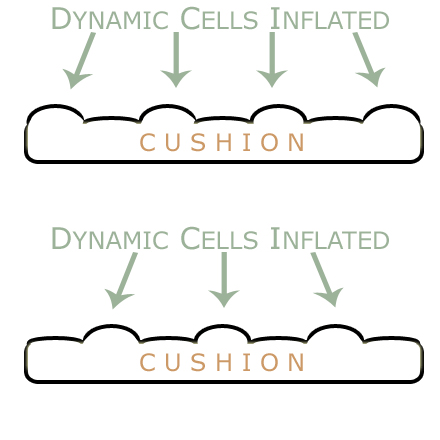
A good dynamic cushion automatically performs temporally cycled pressure reducing actions
at strategic locations across the buttocks area.
Localized blood circulation can be improved by the mechanical action.
The localized pressure reductions occur cyclically at the expense of pressure increases
(of equal magnitude and duration) elsewhere across the cushion's surface.
The result is a superior pressure management seating solution for people whose condition
warrants:
a substantially greater cushion cost,
a not-perfectly-silent cushion sound level (the sound level not being applicable to passive cushions),
and a more complex cushion mechanism which suggests a greater maintenance factor.
assive
cushion pressure management approaches require
that the wheelchair user; in some cases with the assistance of a helper,
be solely responsible for performing the movements that relieve localized buttocks pressures.
A good dynamic cushion automatically performs temporally cycled pressure reducing actions
at strategic locations across the buttocks area.
Localized blood circulation can be improved by the mechanical action.
The localized pressure reductions occur cyclically at the expense of pressure increases
(of equal magnitude and duration) elsewhere across the cushion's surface.
The result is a superior pressure management seating solution for people whose condition
warrants:
a substantially greater cushion cost,
a not-perfectly-silent cushion sound level (the sound level not being applicable to passive cushions),
and a more complex cushion mechanism which suggests a greater maintenance factor.
Whether independently performed, or accomplished with the help of an assistant, manual periodic pressure-relieving bodily movements are part of the "ideal sitting scenario." However, there is real-world evidence indicating that a dynamic cushion like; for example, the high-end Ease model can—alone in some cases—provide adequate pressure relief when the "ideal sitting scenario" is simply not achievable.
 esigns
and efficacies of dynamic cushions vary considerably.
The cushion's power source and controller size,
together with the associated power consumption rate, actuation method, cell topology, operating sound level, alarm features, and MTBF of the dynamic components (e.g., pump motors) are factors that should be considered.
Dynamic cushion seating solutions include
the Ease, Aquila, Biologics, and Chair-Air alternating pressure cushions.
esigns
and efficacies of dynamic cushions vary considerably.
The cushion's power source and controller size,
together with the associated power consumption rate, actuation method, cell topology, operating sound level, alarm features, and MTBF of the dynamic components (e.g., pump motors) are factors that should be considered.
Dynamic cushion seating solutions include
the Ease, Aquila, Biologics, and Chair-Air alternating pressure cushions.
It is of interest to note that wheelchair users can thank Rex Taylor of the Ease cushion company for developing this type of wheelchair cushion, and that the Ease cushion is protected by patent 6014784.
In general, a dynamic cushion is not a requirement for wheelchair users who regularly practice pressure-relieving lifts of sufficient height and frequency. However, there are cases involving wheelchair users with extant pressure sores, and cases involving individuals whose impairment entails high-level quadriplegia; for example, wherein a dynamic cushion is the most effective seating solution for the particular situation. It is also interesting to note that some completely ambulatory pilots (i.e., people with no disability whatsoever)—when restricted to the confines of a plane's cockpit—use dynamic cushion technology (licensed from the Ease cushion company) to prevent pressure sores during long flights.
Copyright © 2009-2026
Wheelchair Cushion Sage.
All Rights Reserved.
